Read the scene. The people, places, and things that matter glow as clues — tap them, collect them, connect them in your notebook to crack the bigger files. Follow the rot up the ladder, from a city-hall blackmail to the man at the very top. Work it your way: a less-than-legal private eye, or a cop trying to stay clean.
PLAY THE BETA — FREE
Install note: Direct APK — enable "Unknown Sources" in settings.
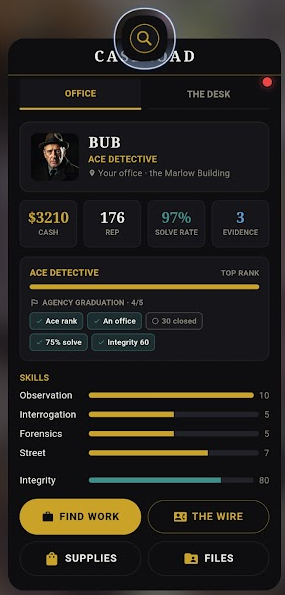
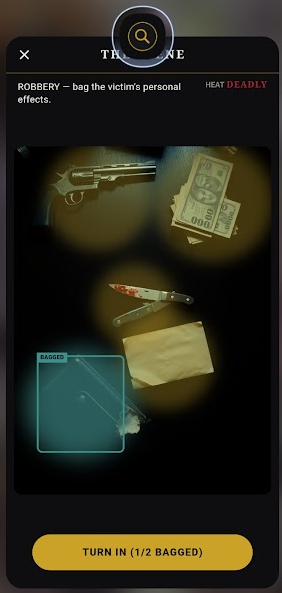
SCREENSHOTS
From the 1940s — the free era
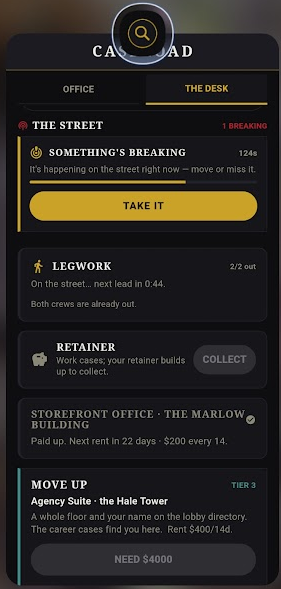
HOW IT PLAYS
A detective, not a slot machine
TAP THE CLUES
Every scene is something you actually read. People, places, things, and gut-feel details glow in their own colors — never labeled lead or dead-end. You decide what matters by working it.
CONNECT THE THREADS
Bank clues in your case notebook and connect the pairs that fit. Small cases feed the big files; the big files point higher — up the ladder toward the man at the top.
WORK THE STREET
Stakeouts, busts, the photo docket, the crime scene — quick skill beats inside the cases. Win them and you bag the hard evidence that makes the big case stick.
TWO BADGES
One city, two sides of the law. Play a private eye who bends the rules, or a cop who works the system. Your methods — and your conscience — are your own.
THE LOCKER
The evidence and favors you bag stack up in your file. The biggest cases only break once you've built it — done the legwork, worked the street.
ALWAYS SOMETHING
An idle loop that feeds itself — cases, leads, the wire, street events, mini-games — all pouring into the same file. You're always one thread from the next.
WALK THE LINE
Stay clean and the brass trust you — or take the money, bank the Juice, and dodge the heat. Slide far enough and, at the very top, you can cut yourself in instead of taking them down. Thread the line, or cross it.
THE WEB ACROSS TIME
Close one era and it cracks open the ones before. The same gun, the same dirty money, the same family keep turning up — a tunnel sealed in '47, a tower built on it in 2008. A hundred and twenty years of crime, all tied together.
FOUR ERAS OF CRIME
Four 30-year eras, 1940 to 2059. A tour through how crime — and the work of catching it — changed. Close one era's biggest case and the next opens.
The first era (1940–1969) plays free, for good. Each later era is $9.99 — or take all three as a bundle for $24.97 (save $5). Free for everyone while the limited beta runs.